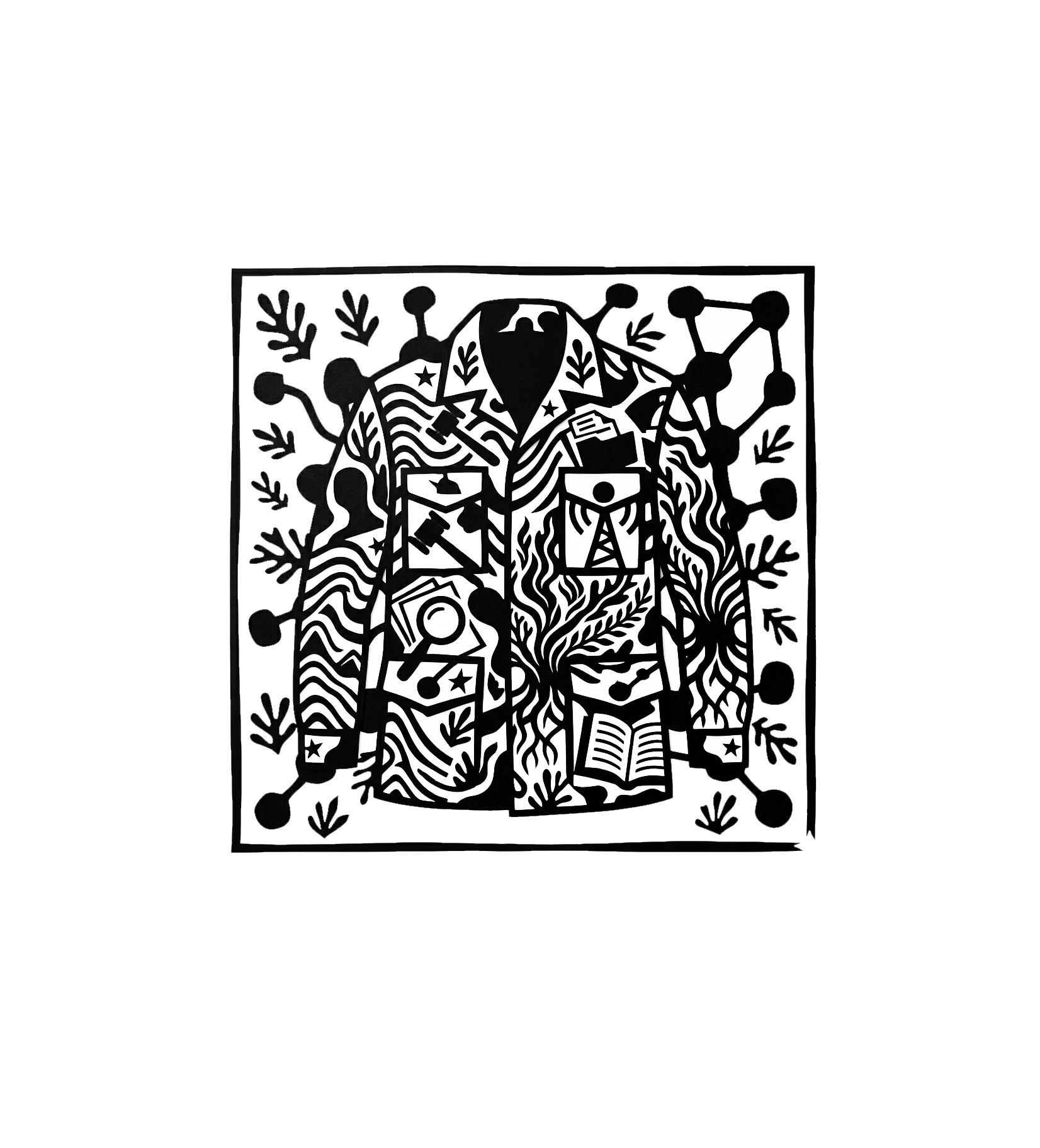
The Hidden State
J’adoube
Jesse Doiron
June 7, 2026
Wage the battle well, m’Lord.
Today we will proclaim
A victory triumphant
All beneath your name.
You sacrifice your soldiers’ lives.
It is indeed a shame,
But there’s an empire they must build,
fashioned in your name.
Have the bugles call them forth,
The canons to take aim.
Call the order for the charge.
Echo loud your name.
Watch the bravest of them all
Fall early in the game.
Order then the second ranks
Fight proudly in your name.
Your soldiers’ lives are sacrificed.
It is indeed a shame,
But there’s an empire to be built,
fashioned in your name.
So bury them and burn them
In pits or pyres of flame,
And raise them up some monuments
To manifest your name.
Wage the battle well, m’Lord.
Today, we will proclaim
A victory triumphant
And all beneath your name.
Jesse Doiron has worked in Europe, the Middle East, and Asia as an educator and consultant. His teaching experience ranges from English for international business at the UC – Berkeley Extension in San Francisco to creative writing at the Mark Stiles Maximum Security Prison for the Texas Department of Criminal Justice.
Explication of “J’adoube”
The title is a French phrase meaning “I adjust.” It excuses a player from the rule requiring movement of any piece touched during play. Under j’adoube, a player may correct the placement of a sitting piece to clarify its place on the board without having to move it to another position on the board.
The poem masquerades as a panegyric. In fact, it is an encomium-in-cheek, praising a narcissistic leader intent on personal glory at the cost of his soldiers’ lives.
Chess is a metaphor for actual war. The poem depicts war as a game of chess. The American attack on Iran has been a poorly planned act of war against a well-prepared adversary.
While chess originated in India about 1,500 years ago, it spread within a few centuries to Persia (modern-day Iran) more than a thousand years ago. The Persian version of the game grew from its Indian roots and eventually developed many of the rules that most players still follow in the 21 st century.
With its emphasis on strategy and strength, chess is easily a metaphor for what we are experiencing today in the Middle East – a conflict that has brought strife and confusion to much of the world.
Donald Trump’s inept handling of battle, like a novice chess player, has given up the advantage of strength on the board to a weaker opponent who has the advantage of position on the board.
Checkmate seems an unlikely prize in Trump’s undeclared war. Stalemate seems the best Trump can obtain.
Two Cats, Two Dogs, a Bird, the Sun
Chris Ellery
May 3, 2026
Inside an egg in Il Museo Galileo
in the city of Dante and Beatrice and Leonardo
and Michelangelo, a middle finger of the astronomer
ambiguously points heavenward.
Feel the scientist’s presence here at my son’s house
in the city called The Yellow Rose of Texas,
“Bomb City,”
city of nukes and helium.
Earth is un-tilting toward its renaissance,
near perpendicular in its revolution, vernal equality
of day and night. And in this season of regreening,
what Galilei could bear to think of leaving?
Two cats and two dogs stare out the storm door,
devotees rapt in the shimmer of atomic power,
all silent on their haunches and as still
as statues of Anubis.
Far from the mortuary bitterness of pyramid blackness,
an awakening redbud lives in sunny brightness,
its shadow imperceptibly advancing on the grass,
sundial evidence of heliocentric rightness.
Beneath our nearest star, pansies contemplate
the mud. The live oaks drop their leaves.
Plum and pear begin to bloom. A cardinal
blazes in the beams, calling to his nesting mate.
In his cheery song, a young madonna passes,
pushing a stroller, her stardust baby just beginning
to comprehend the Empyrean vastness
and the rhythm of the turning.
Indifferent to all this flow, the geocentric
pope or king would blast design
and torture every satellite to keep all things
within the self-sustaining gravity of status quo.
And most of us would bend to power, I suppose,
pretend to faith in any nonsense, give fact the bird
for one more orbit, one more year of chiaroscuro—
nay, but one more hour! After all, the sunshine falls
with equal glory on the graves of hero and heretic
martyr and liar. Truth doesn’t need our witness
or permission. The same stars dance forever in bliss
in the perfect eyes of Beatrice.
Chris Ellery is the author of six poetry collections, including The Big Mosque of Mercy, based on his residence in Syria and travels in the Middle East. He is the recipient of the X.J. Kennedy Award for Creative Nonfiction and the Texas Poetry Prize.
Propaganda masquerading as “truthiness” is a staple of political discourse, but the current U.S. president and his cohorts have amped up their attacks on the facts and those who reveal them to a level generally seen only in police states. As far as I know, people haven’t been spirited away and executed in the middle of the night, but certainly the DoJ and DHS have been weaponized to discourage free speech that offends Donald Trump.
Primarily through the allusion to Galileo Galilei, my poem uses the Historical Topographical Pattern to expose and ridicule those who suppress truth, and secondarily those who deny or conceal the truth they know because they fear the consequences if they don't. The poem also attacks the military-industrial complex and our culture of both personal and institutional violence.
State of the Bluebonnet
Irene Keller
May 3, 2026
Bluebonnets replace dull fields of winter,
promise new beginnings, renewed hope;
natural freedom of blue dissuades being
uprooted for personal wants of ownership.
A bluebonnet put into the hands of every child
to place on one preferred altar, as ancient stories
are taught, inhibits youth’s need to skip through
bonnets of blue that kiss the wind not owned.
The Key
The title offers a double meaning: the state flower bluebonnet is a familiar symbol for Texas; the title is also a bureaucratic reference to TEA’s corrupt use of bluebonnet as a title for the K-5 Bluebonnet Learning curriculum that includes biblical stories, an influential means of building Christian nationalism, while also violating separation of church and state.
The hinge poem contrasts the natural, free-flowing wave of bluebonnets to TEA’s misleading use of the nonpartisan, beauty of the state flower, camouflaging the promotion of one religion, with a money incentive for financially challenged ISDs to adopt.
The poem applies the environmental camouflage theme: bluebonnets are not to be owned by anyone, a metaphor for religious freedom.
Irene Keller, PhD. A former Texas public educator who can now indulge herself in the world of poetry.
Death Cap Mushrooms of the Big Thicket
Jesse Doiron
April 5, 2026
The mushrooms while away in undergrowth;
wet weather there will tell them when to spore,
mycelia, more plentiful than oak
in this archipelago of thickets.
The mushrooms, clad in soft impressions, seem
mere shadows cast upon the forest floor.
But they, in thick and musky silence, scheme,
on tiptoe, quietly, from tree to tree.
The mushrooms hide in towns beneath the yards,
tie threads of wisp in knots between the lanes,
and string them out along the piney trails,
poisoning the tamed and untamed places –
where feral hogs know well which ones to eat,
but careless men, content, consume the treat.
Jesse Doiron has worked in Europe, the Middle East, and Asia as an educator and consultant. His teaching experience ranges from English for international business at the UC – Berkeley Extension in San Francisco to creative writing at the Mark Stiles Maximum Security Prison for the Texas Department of Criminal Justice.
Read Jesse’s explication here.
the live oak grove still grows
d. ellis phelps
April 5, 2026
beside the big
white house
on the hill
the live oak grove
still grows
the grove has grown there
long and sweet
so the story goes
~
some say
the grove is totally wrong
—unsightly mess that doesn’t belong
and every spring on everything
all that green so much green
~
bringing axes
some have come
to cut the growing grove
but the roots have spread
—have taken hold
& far from the booted tread
through mycorrhizal
millions
underneath
rise resilient live oak heads
d. ellis phelps is the author of five collections of poems, most recently, book of common breath (Kelsay Books, 2026).
Lordean Key:
In this poem, I use an environmental shell to protect multiple signals I wish to send. The heartbeats include an individual’s rights or group of individuals rights to exist in their own form and as a unique identity, the live oak, alongside the bureaucratic powers that be without being cut down; the fact that bureaucracies misuse their power, axes, to try to suppress and eliminate that which they deem unsightly; and the power of individuals in community, the grove, to be resilient and to continue to grow by forming networks, mycorrhizal, making unseen connections or going underneath.